
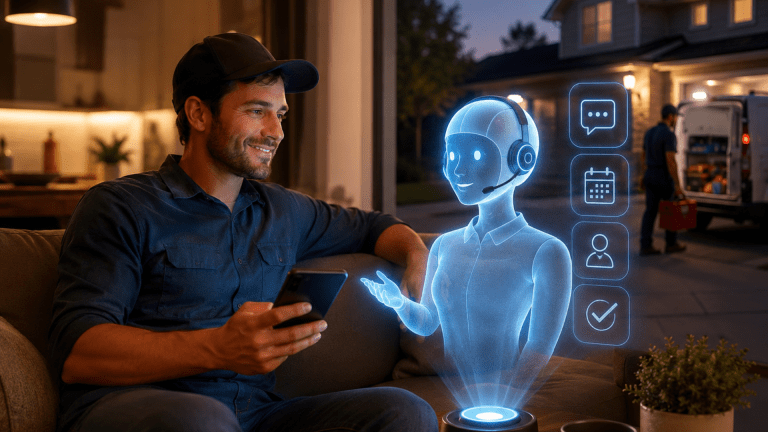
It is 9:47 PM on a Thursday. A homeowner in Tampa notices water pooling beneath their kitchen sink. They grab their phone, search for a local plumber, find your business at the top of Google, and call your number.
Your phone rings in your pocket. You are at dinner with your family. You do not answer. The call goes to voicemail. The homeowner does not leave a message. They scroll down the results and call the next plumber on the list. That business answers. They book the job.
You find out about it the next morning when you check your missed calls. Another lead gone. Another job your competitor is driving to right now instead of you.
This is not a hypothetical. This is happening to home service businesses across Tampa every single night. And the businesses that have figured out how to stop it are not hiring night-shift receptionists or paying expensive answering services. They are deploying AI employees that handle every incoming lead, around the clock, for a fraction of the cost of a single part-time hire.
The Scale of the After-Hours Problem in Home Services

Before talking about the solution, it is worth fully understanding the size of the problem, because most home service business owners significantly underestimate it.
Most home service businesses lose about 27% of their incoming calls. That is roughly one in four calls going unanswered. For a contractor receiving 20 calls daily, that is 168 potential customers every month who never get through.
The worst part is that 85% of callers who reach voicemail do not bother leaving a message. They move on to the next contractor immediately. When someone has a plumbing emergency at midnight or their AC dies during a heatwave, they are not waiting around. They are booking whoever picks up first.
CallRail benchmarking confirms that up to 85% of customers whose calls go unanswered do not call back. Home services appear among the industries with the most meaningful missed-call rates. Home services depend on speed. When an AC fails in July or a water heater leaks at night, the customer wants a fast answer. If they get voicemail, they often move on.
A typical plumbing business receives 8 to 12 emergency calls weekly outside business hours. Miss those calls, and you are potentially leaving $247,000 in annual revenue on the table. For HVAC companies, electricians, and other contractors, the numbers are equally dramatic.
And then there is the advertising angle that makes this even more painful. You are spending money on Google Ads, local SEO, and listings to generate those calls. Every unanswered call after 5 PM is paid marketing spend converting directly into a competitor’s booking.
Why Traditional Solutions Have Never Truly Fixed This

Most Tampa home service businesses have tried some version of a fix for the after-hours problem. The approaches are usually some combination of checking messages at the end of the day and calling back the next morning, using an automated voicemail with a callback promise, or paying for a live answering service.
None of these actually solve the problem. Here is why.
Calling back the next morning runs headlong into the speed-to-lead data that has been covered extensively in this blog series. By the time you call back at 8 AM, the homeowner has already booked someone else. The callback is not a solution. It is a polite acknowledgement that you lost the job.
Voicemail has already been addressed in the data above. Most people do not leave one. They expect an immediate response, and when they do not get it, they move on in under thirty seconds.
Live answering services are expensive, inconsistent, and limited. They answer the phone, but they cannot book directly into your calendar, they cannot qualify the lead properly, and they hand off a message that still requires a human to follow up. You are paying for a middle step that still leaves the lead unresolved.
AI receptionists offer a better balance. They help businesses stay available 24 hours a day, seven days a week, without overloading employees.
By handling calls, answering basic questions, and taking messages, these virtual assistants ensure every caller feels heard, day or night. In competitive industries like healthcare, home services, and retail, that quick response often determines who wins the customer.
What an AI Employee Actually Does When Your Phone Rings at 10 PM
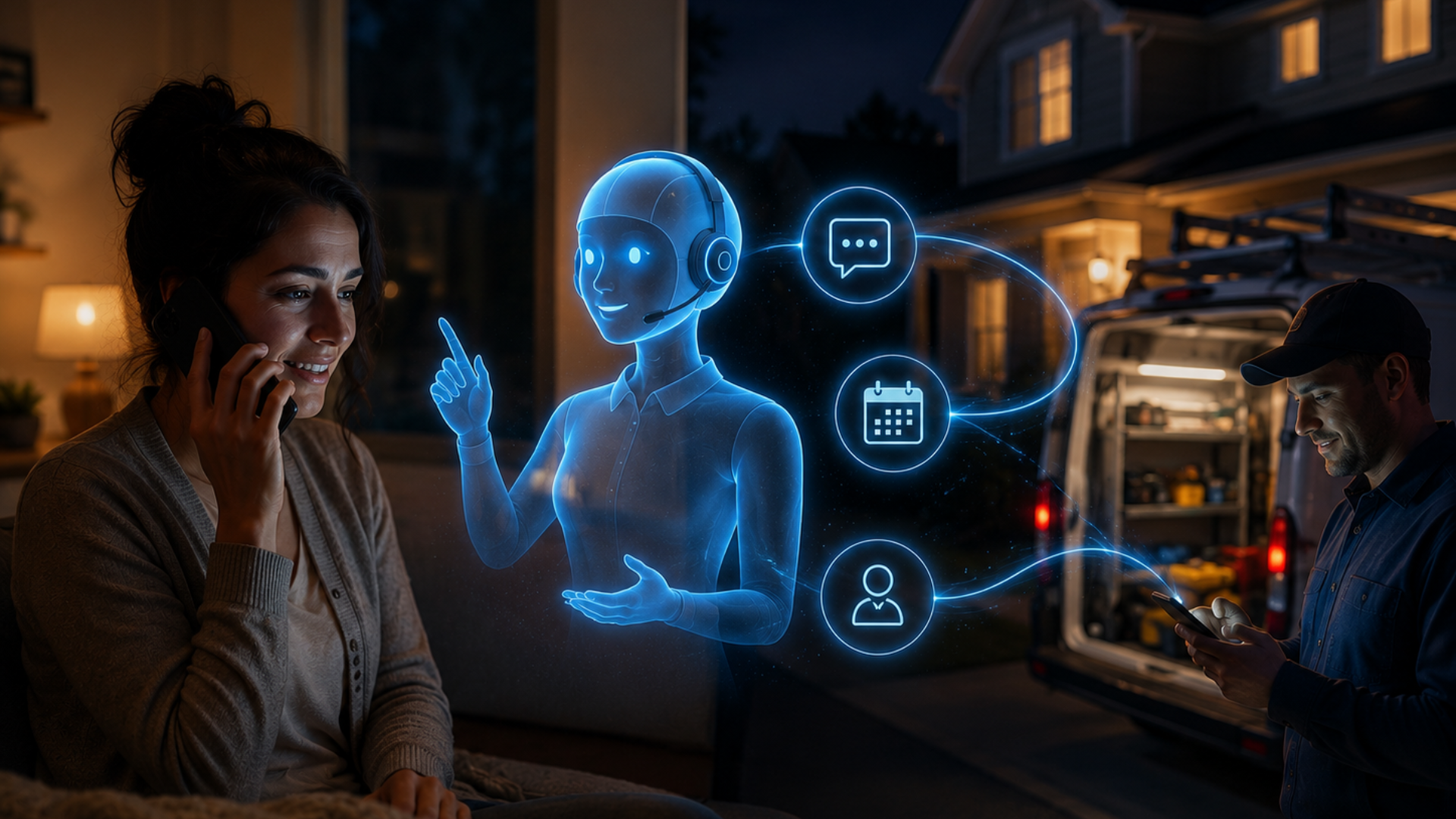
An AI employee for a home service business is not a phone tree. It is not a hold queue. It is not a robot reading a script from a list of options. It is a trained, conversational system that handles the call the way a good front desk person would, except it is available at any hour, never gets tired, and never misses a call.
An AI receptionist can be trained on your business information, including your website, FAQs, uploaded documents, business hours, services, and policies. It captures leads using customizable intake questions, updates your CRM systems, integrates with your calendars, and can answer every call during business hours, after hours, weekends, and holidays.
When your phone rings at 10 PM from a homeowner with a burst pipe, the AI employee answers immediately. It engages in a natural conversation, asks the right qualifying questions like the address, the nature of the problem, and the urgency level.
It collects the caller’s contact details, provides reassurance about what happens next, books a callback or appointment slot directly into your calendar, and sends a confirmation text to the homeowner. All of this happens in real time while you are at dinner.
You wake up the next morning to an organized log of every call, the details captured from each one, and your schedule already populated with the jobs that came in overnight.
A home services company that added an AI receptionist for evening coverage saw a 70% drop in missed calls. The team came in each morning with organized call logs and clear action items, not a cluttered voicemail box.
The Specific Outcomes Tampa Home Service Businesses Are Seeing

The results from AI employee deployment in home services are not theoretical. They are measurable and consistent across the industry.
Lead capture rates increase 40 to 60% when every call gets answered within seconds, and more inquiries convert to booked appointments. Contractors report capturing evening and weekend calls they previously missed entirely.
Administrative time decreases by 5 to 10 hours weekly with no more manual call logging, appointment entry, or message management. After-hours revenue jumps significantly, with plumbers capturing 40% more emergency calls during weekends and evenings and HVAC companies booking consultations while competitors’ phones ring unanswered.
57% of U.S. homeowners believe that home service businesses integrating AI will lead to better customer service. And 85% of customers will not give your business a second chance after you miss their call.
There is also a consistency advantage that is easy to overlook. Home services calls are repetitive. The business needs the same intake information most of the time: address, problem description, urgency, and preferred time.
AI employees ask those questions consistently and capture cleaner notes than a rushed front desk during peak hours. That data can also improve your reporting, making it easier to track how marketing affects inbound demand and measure conversion rates by source.
How AI Employees Handle the Emotional Complexity of Emergency Calls

One concern Tampa home service business owners raise when they first hear about AI employees is what happens when a caller is distressed. A homeowner whose basement is flooding at midnight is not in a calm, transactional mindset. Will an AI employee handle that well?
The answer is not to avoid AI entirely. The answer is to design smart escalation rules. An AI employee can be configured to recognize urgency signals in a conversation and immediately escalate to a human callback, a live transfer, or an emergency on-call line when the situation calls for it.
Modern AI employees sound conversational and friendly. Most callers do not even realize they are speaking to an AI, especially when it is customized to match your brand tone. When a call does need to be transferred, the AI routes the caller to the correct person and includes a full call summary so the customer does not have to repeat themselves.
The AI handles the intake, the qualification, and the booking. The human handles the complex emotional situations that genuinely require a person. That division of labor is what makes the whole system work.
Connecting AI Employees to Your CRM for Maximum Impact
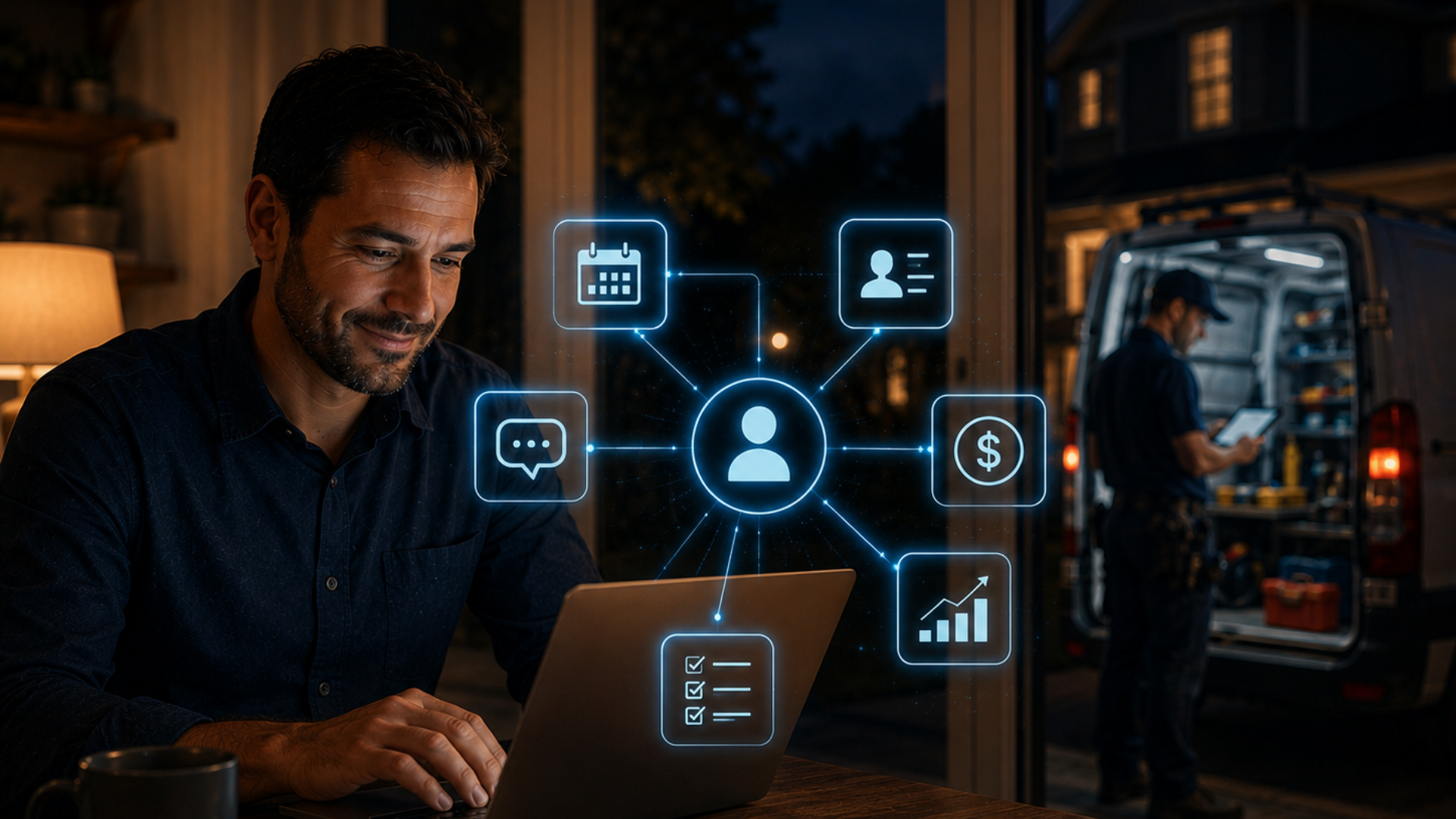
An AI employee that answers calls but operates in isolation from your broader business systems is only solving half the problem. The real power comes from connecting your AI employee directly to your CRM so that every lead captured after hours flows automatically into your pipeline, triggers a follow-up sequence, and is visible to your team the moment they start their day.
AI-driven tools will provide 24 hour support, answering customer inquiries and booking appointments. An AI phone call assistant can ensure that you never miss a call, working around the clock to answer customer questions, schedule callbacks, and note appointment requests.
Automated responses also provide a quick follow-up for missed callers and missed call reports provide the insights needed to optimize every follow-up.
When this system is built correctly, the AI employee and the CRM work together as a single lead capture and nurture engine. A call comes in at 11 PM. The AI employee handles it. The lead is created in the CRM automatically.
A follow-up text sequence is triggered. The lead is assigned to a team member. And when your team arrives in the morning, the job is already half sold before anyone picks up a phone.
Flying Goat Agency Builds These Systems for Tampa Home Service Businesses
At Flying Goat Agency, we build AI employee and CRM automation systems specifically configured for Tampa home service businesses. We handle the setup, the training, the CRM integration, and the escalation rules so your AI employee handles every after-hours lead the way a great front desk person would, without the overhead, without the inconsistency, and without the business hours limitation.
We connect this directly to your lead generation campaigns so that every dollar you spend on Google Ads or local SEO generates a lead that is captured, qualified, and followed up with immediately regardless of when the call comes in.
The Tampa home service businesses that are pulling ahead of their competitors right now are not necessarily the ones with the best technicians or the lowest prices. They are the ones with the best systems. An AI employee that never misses a call is one of the highest-leverage systems any home service business can build. Let us build it for you.